



 Blogs
Blogs
B2B Guide to Restaurant PVC Tablecloths: Pros and Cons
Restaurant owners often face challenges in balancing visual appeal, daily functionality, and budget limitations when selecting the right table coverings for their dining spaces. In recent years, PVC tablecloth have become increasingly popular across restaurants, cafés, and other food service institutions due to their practicality. While these synthetic table covers may have a few drawbacks compared to traditional fabric linens, they also provide several advantages such as durability, easy cleaning, and cost efficiency. Understanding both the benefits and limitations allows restaurant managers to make well informed decisions before investing in table coverings.
Best Use Cases for PVC Tablecloth
An overview of PVC tablecloth
PVC tablecloth is a plastic polymer. PVC tablecloth are made of vinyl that is occasionally supported with fabric or foam to make it stable. The content is available in many sizes, textures, and designs. PVC tablecloth that look like fabric, leather, and other materials can be manufactured in this process.
Different Types Available
The decorative tablecloths have clear PVC guards that help prevent damage. Printed PVC tablecloth feature patterns, colors, or designs pressed into the cloth. Embossed ones have uneven surfaces. Flannel-backed PVC has a soft backing that prevents slipping on table surfaces.
Key Benefits of PVC Tablecloth for Buyers
Waterproof Protection
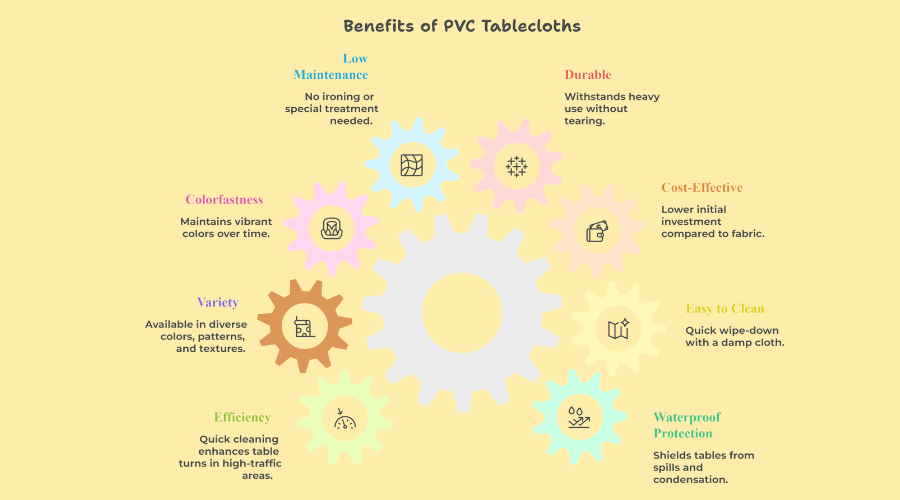
PVC provides a waterproof layer beneath tables, helping keep spills and condensation protected. Water rings and surface stains are avoided because liquids cannot penetrate the material. This waterproofing is indispensable in crowded restaurant settings, where everyday spills are common.
Easy Cleaning
PVC tablecloth can be wiped within a few seconds using a damp cloth. There is an expansion of most spills and food debris, which can be washed off easily without any special cleaners. Stains do not absorb into the smooth surface, as they do in fabric. The rapid service between clients ensures that the tables are ready to serve the client without having to delay for laundering.
Cost Savings
PVC tablecloth are much less expensive than high-quality fabric linens at first. The savings are multiplied by eliminating laundering costs. There are no laundry service charges, detergent costs, or transportation expenses. These savings play off advantages in the restaurant budgets in the long term.
Durability
High-quality PVC can be used heavily without tearing or losing thickness. The material does not fade under exposure to sunlight. PVC is unlikely to form any holes under the influence of accidental burns in comparison with fabric. Tables are consistently good-looking over a long time.
Low Maintenance
PVC does not need ironing, starching, or special treatment. There is easy storage, and it does not have to worry about wrinkles or moisture damage. The material is easily usable without preparation. Employees will be able to focus on customer service rather than linen management.
Consistent Appearance
PVC does not fade in terms of color or texture. Linen fabrics start to fade and create worn-out spots. The uniform design keeps restaurants from losing their aesthetic touch. Replacement needs are neither frequent nor predictable.
Variety of Styles
PVC tablecloth in the modern world are available in an endless number of colors, patterns, and textures. The range will span from luxurious damask designs to ordinary gingham. The diversity allows for any restaurant theme or style. It is cheap to use low-cost PVC to achieve seasonal changes.
Quick Table Turnover
Wiping comes up quicker than changing dirty linens. This pace enhances potential table turns during rush time. The number of customers served on a given shift directly affects revenue. The efficiency is particularly useful during rush hours.
The drawbacks of PVC Tablecloth
Less Elegant Appearance
Despite this, PVC cannot accurately depict the advanced drape and texture of fabrics. Fine dining restaurants might not see PVC as fitting their high-end image. The content may be low-end even when it is made of high-quality. Premium restaurant establishments are concerned with visual and tactile differences.
Environmental Concerns
PVC manufacturing involves petroleum products and potentially dangerous chemicals. The substance cannot break down naturally, posing a disposal problem. PVC may raise environmental concerns among diners. Sustainability could mean that restaurants will opt to use other materials.
Heat Sensitivity
PVC surfaces may be damaged by hot plates and dishes that leave marks or spots on the registered surface. When placing hot objects, care must be taken to avoid damage. The use of trivets or heat-resistant pads complicates table service. Certain service styles are limited in application due to heat sensitivity.
Chemical Smell
New PVC tablecloth sometimes have a plastic odor. These odors are repulsive in eating places. It helps to air new tablecloths, which adds time to the preparation. The smell gradually fades, but it raises initial concerns.
Limited Lifetime
It is durable, though PVC can crack, become brittle, or permanently crease. This can be replaced after prolonged usage. It is not an age-old material that matures beautifully, like fine linen. Periodic replacement has to be planned.
Slipping Issues
Polished surface tables may have smooth PVC surfaces that slide, resulting in service issues. Objects on tables can be slipped, resulting in customer dissatisfaction. Flannel backing is expensive, but it works. The sliding poses both operational and technical aspects.
Less Comfortable Feel
PVC is not as soft as fabric when the arms lie on tables. Artificial fabrics can be less comfortable than cloth. This physical contrast creates quite an experience of change in the dining area. Customer comfort affects overall satisfaction.
Size Limitations
Personalized size of PVC tablecloth is more complicated than cutting cloth. Table sizes might not be precise for all sizes. Covering that does not fit well appears unprofessional and is not functional. Tailor-made orders add to expenditures, diminishing financial benefits.
Grab PVC Tablecloths at Wholesale Prices
Compared to Fabric Linens
Upfront Costs
Fiber linens are more expensive in the short run but have the old-fashioned appeal. Good-quality tablecloths require significant initial investments. PVC requires lower start-up capital, freeing funds for other demands. Startup budgets are one of the sectors affected by cost differences.
Ongoing Expenses
The cloth will need re-washing due to the ongoing costs. These expenses are commercial laundry, energy, and labor. PVC eliminates such recurring expenses upon purchase. PVC would be advised in long-term analysis with respect to low-cost operations.
Aesthetic Considerations
Multiple fabric coverings so well recreate an elegant atmosphere. The substance is luxurious, adding a touch of exquisiteness to dining life. PVC takes a back seat to this elegance, even with the advances. It depends on the positioning of restaurants as to which aesthetic is the most important.
Practical Functionality
Cloth plays an immediate role in spills that need washing. PVC does not absorb liquids and can be cleaned up easily without necessarily being changed. Functional priorities vary by establishment. PVC functionality is more useful in high-volume casual restaurants.
Optimal Restaurant models of PVC Tablecloth
Casual Dining
PVC tablecloth are pretty suitable for family restaurants and casual eateries. The utility of the settings does not outweigh decorative drawbacks. Value and service are more important to customers than linen quality. PVC is consistent with casual dining.
High-Volume Establishments
Restaurants with a high number of customers in a day require a good table turnover. PVC cleaning rate allows serving more customers. It is more durable and can be used extensively when compared with fabric. PVC saves a lot of money for volume operators.
Outdoor Seating
Waterproof PVC is useful in patios and other outdoor areas. Outdoor factors and weather exposure ruin clothing very fast. PVC is better able to withstand both sunlight and moisture changes, as well as temperature changes. PVC's characteristics are ideal for outdoor environments.
Budget-Conscious Operations
PVC is cost-effective for establishments looking to reduce overheads. Eliminating laundering expenses frees resources for other priorities. This is especially beneficial for new restaurants, as it helps them save on capital. PVC is attractive to budget management.
Factors to Consider Before Making the Decision
Evaluating Priorities
Restaurant managers should set priorities for their restaurants. There is cost control, cost efficiency, appearance, and customer expectations. There is no single solution to all situations. Realistic evaluation leads to the right decisions.
Reflecting on Hybrid Approaches
Special-occasion PVC is used in some restaurants, while everyday service is done with fabric. This compromise is a cost control and a compromise on presentation. The versatility will meet a range of requirements within a single facility. The optimal use of the two materials is strategic to the maximization of benefits.
Daily Cleaning Tips and Recommendations

Storage Practices
Lay PVC tablecloth, either flat or loosely rolled, without creasing. Sharp folding should be avoided as it makes the material weak along the fold lines. Stored tablecloths should not be kept near the heat. Good storage keeps the appearance and conservation.
Damage Prevention
Place hot food on trivets or a heat-resistant mat, taking care of PVC. Cutting directly on tablecloths that have a surface integrity is prohibited. At once, a spurring of tears. Preventive maintenance lowers turnover rate.
Regular Inspection
Periodically examine tablecloths or check always cloths for damage, discoloration, or wear. Fix broken pieces and use them simultaneously, keeping the overall look the same. Early identification will mean not using the wrong tablecloths. Frequent check-up ensures quality.
Future Trends
Material Improvements
Manufacturers are still developing better formulations of PVC. New versions are more like fabric in appearance and feel. Environmental issues fuel biodegradable alternatives. Innovation slowly eliminates existing constraints.
Sustainability Developments
Increasing environmental awareness is affecting materials. Recyclable, environmentally friendly PVC substitutes are emerging. There is growing concern about environmental issues in restaurants. Environmentally friendly solutions will definitely become much broader.
Conclusion
PVC tablecloth offer restaurants a practical and budget friendly solution by combining cost efficiency, durability, and ease of maintenance. These tablecloths are resistant to spills, stains, and daily wear, which helps reduce replacement and cleaning costs over time. By understanding both the advantages and possible limitations of PVC tablecloth, restaurant owners can make informed decisions that support smooth operations, maintain a clean dining environment, and enhance overall customer satisfaction.
Frequently Asked Question (FAQ’s)
Which material is good for custom PVC tablecloth?
The best material for a custom PVC tablecloth is high quality flexible PVC with a soft backing, as it offers durability, water resistance, easy maintenance, and excellent print clarity for custom designs.
How to clean PVC tablecloth in a washing machine?
To clean a PVC tablecloth in a washing machine, use a gentle cycle with cold water, mild detergent, avoid bleach, and air dry to prevent cracking or damage.
Can a PVC tablecloth be used for outdoor tables?
Yes, a PVC tablecloth can be used for outdoor tables because it is waterproof, stain resistant, easy to wipe clean, and protects surfaces from sunlight, spills, and weather exposure.
Is a PVC tablecloth easy to clean?
Yes, PVC tablecloth is very easy to clean as most spills can be wiped away with a damp cloth, making it ideal for homes, events, restaurants, and commercial use.
Important Resources:
Featured Articles
Introduction When importing tablecloths in bulk, buyers need to evaluate more than the product price. A successful bulk order depends on material quality, tablecloth sizes, design options, durability, minimum order quantities, supplier capacity, packaging, customization, and shipping requirements. Importers should also consider the needs of their target customers, whether they supply restaurants, hotels, retailers, event planners, wholesalers, or catering businesses. This article will explain the main factors importers should check before placing a large tablecloth order. It will help B2B buyers compare products and suppliers more carefully, reduce sourcing risks, and choose tablecloths that are suitable for their target market. 1. Identify Your Target Market Before Buying Tablecloths Before contacting a tablecloth supplier, importers should understand who will purchase the products after they arrive in their market. A retailer may need different colors and sizes than a restaurant supplier, while an event company may prioritize affordable and easy-to-handle tablecloths. Defining the target market first helps buyers select products that have practical commercial demand. Understand the Needs of Restaurants and Hotels Restaurants and hotels usually need tablecloths that can handle frequent use, washing, cleaning, and repeated handling. Buyers supplying these businesses should focus on durability, easy maintenance, suitable sizes, and professional appearance. The material should also match the type of dining environment and cleaning process used by the target customers. Consider Retailers and Wholesale Customers Retailers often need a wider product range because their customers may have different preferences for colors, materials, sizes, and designs. Importers supplying retail stores should consider products that can appeal to different customer groups. Offering several practical options can help distributors create a stronger table linen range without unnecessarily increasing inventory. Consider Event and Catering Businesses Event planners and catering companies may require tablecloths for weddings, parties, conferences, restaurants, and other occasions. Their priorities may include appearance, affordability, ease of handling, and availability in large quantities. Importers serving this market should consider whether the selected tablecloths suit repeated events and large-scale orders. 2. Choose the Right Tablecloth Material Material is one of the most important factors when buying tablecloths in bulk. Different materials provide different levels of durability, appearance, maintenance, water resistance, and cost. Importers should compare materials according to their target application instead of selecting a product only because it has a lower unit price. Compare Polyester Tablecloths Polyester tablecloths are commonly considered for restaurants, hotels, events, retailers, and other commercial applications because they can offer a balance between appearance, durability, and practical maintenance. Importers should compare fabric quality, thickness, stitching, color consistency, and finishing before ordering large quantities. Top 5 Features to Look for in a Polyester Tablecloth Evaluate PVC Tablecloths PVC tablecloths can be suitable for buyers looking for an easy-to-clean and practical surface covering. Importers should check surface quality, thickness, flexibility, printing quality, and overall finishing. The intended market should also be considered because requirements can differ between household, restaurant, catering, and commercial customers. B2B Guide to Restaurant PVC Tablecloths: Pros and Cons H3: Consider Nonwoven Tablecloths Nonwoven tablecloths can be useful for event planners, catering businesses, and other applications where buyers need practical and cost-effective table covering solutions. Importers should check material consistency, available colors, sizes, packaging, and intended usage before placing a large order. Why Distributors Prefer Nonwoven Tablecloths for Event Planners & Importers 3. Check Tablecloth Size and Dimensions Choosing the correct size is essential because tablecloths need to provide suitable coverage for different table shapes and sizes. Importers should not assume that one standard size will satisfy every customer. Before ordering, buyers should review the dimensions offered by the supplier and compare them with the tables commonly used in their target market. Check Standard Tablecloth Sizes Importers should identify the most commonly requested tablecloth dimensions in their market. Standard sizes can make inventory planning easier and help retailers or distributors serve customers more efficiently. Buyers should also confirm whether the supplier measures products before or after production and whether there may be any acceptable size variation. Consider Different Table Shapes Round, square, rectangular, and other table shapes can require different tablecloth dimensions. Importers should understand which table shapes are common among their customers and select products accordingly. Offering suitable sizes for multiple table shapes can help distributors build a more useful product range. Ask About Custom Sizes Some commercial buyers may need custom dimensions for specific tables, venues, restaurants, hotels, or events. Importers should ask suppliers whether custom sizes are available and whether customized dimensions affect MOQ, production time, or pricing. These details should be confirmed before placing a bulk order. 4. Evaluate Tablecloth Quality and Durability Product quality directly affects customer satisfaction, repeat orders, returns, and the reputation of an importer or distributor. A tablecloth may appear attractive in product photographs but perform differently in actual commercial use. Importers should therefore evaluate physical samples and inspect important quality factors before confirming a large shipment. Check Fabric or Material Thickness Thickness can affect the overall feel, durability, appearance, and performance of a tablecloth. Importers should compare the thickness or weight of samples with the supplier's stated specifications. Buyers should also determine whether the selected thickness is appropriate for restaurants, retail customers, events, or other target applications. Inspect Stitching and Edges Poor stitching or unfinished edges can reduce the useful life of a tablecloth and create customer complaints. Importers should inspect seams, hems, corners, and overall finishing when reviewing samples. Consistent stitching is especially important when ordering large quantities because quality should remain stable across the entire shipment. Check Color and Surface Finish Color consistency is important when purchasing tablecloths for retail or commercial distribution. Importers should compare samples with the supplier's product specifications and confirm whether colors can remain consistent between production batches. Surface appearance, printing quality, texture, and finishing should also be reviewed before bulk production. 5. Compare Tablecloth Designs and Colors Design selection can have a major effect on product demand, especially for retailers, wholesalers, and distributors. Importers should study the preferences of their target market before selecting a large number of colors or patterns. A practical product range should balance customer choice with inventory management. Choose Colors Based on Market Demand Different markets may have different preferences for tablecloth colors. Restaurants may prefer neutral or professional shades, while event planners may need brighter or seasonal colors. Importers should use customer demand, previous sales data, competitor research, and market trends when deciding which colors to order. Compare Solid and Printed Designs Solid tablecloths can offer broad commercial use, while printed designs may target specific customer groups or occasions. Importers should evaluate whether their customers prefer simple products or decorative designs. Instead of purchasing too many variations, buyers can start with commercially relevant designs and expand the range based on sales performance. Plan Seasonal Tablecloth Products Seasonal events can create demand for specific colors and designs. Importers supplying event planners and retailers may consider products for weddings, holidays, parties, conferences, and other occasions. However, seasonal inventory should be planned carefully because unsold products can occupy warehouse space after the relevant period ends. 6. Check MOQ and Bulk Pricing Minimum order quantity is a major consideration for importers because it directly affects inventory investment and purchasing decisions. Suppliers may set different MOQs for different materials, sizes, colors, designs, and customized products. Buyers should understand these conditions before comparing suppliers or calculating the profitability of a bulk order. Understand MOQ Per Product and Color A supplier may have one MOQ for standard products and another MOQ for customized colors or designs. Importers should ask whether the MOQ applies to the complete order or each individual size, color, and design. This information helps buyers avoid unexpected inventory commitments. Compare Unit Price With Total Cost The lowest unit price does not always represent the best purchasing option. Importers should consider product price, packaging, customization, shipping, duties, warehouse costs, and other expenses. Comparing the total landed cost can provide a more realistic picture of the profitability of a bulk tablecloth order. Consider Long-Term Pricing Importers planning repeat orders should ask suppliers about pricing for future purchases. Large or regular orders may provide opportunities for better commercial terms. However, buyers should avoid choosing a supplier based only on price and should also consider quality consistency, production capacity, delivery time, and communication. 7. Evaluate the Tablecloth Supplier Before Ordering Supplier selection is one of the most important parts of B2B sourcing. A supplier may offer attractive prices but still create problems if production capacity, quality control, communication, or delivery performance is unreliable. Importers should evaluate suppliers using several factors instead of relying on price alone. Check Manufacturing Capacity Importers should determine whether the supplier has enough production capacity to handle their required quantity. This is particularly important for distributors and wholesalers that may need regular or large shipments. Buyers should also ask about normal production lead times and how the supplier manages high-volume orders. Review Supplier Experience Experience with international B2B orders can be useful when selecting a supplier. Importers should consider whether the supplier understands export packaging, documentation, product specifications, and international shipping requirements. A supplier that understands these processes may make bulk purchasing easier for overseas buyers. Evaluate Communication and Support Clear communication can prevent misunderstandings about product specifications, quantities, colors, packaging, and delivery schedules. Importers should assess how clearly a supplier answers questions and whether it provides product details in writing. Good communication is especially important for customized or repeat orders. 8. Request Samples Before Placing a Bulk Order Product samples allow importers to evaluate the actual tablecloth instead of relying only on photographs or product descriptions. This step is particularly important for first-time orders because small differences in material, color, thickness, size, or finishing can become significant when multiplied across a large shipment. Compare Samples With Product Specifications When the sample arrives, buyers should compare it with the agreed specifications. Check dimensions, material, thickness, color, stitching, finishing, packaging, and other important details. Any differences should be discussed with the supplier before bulk production begins. Test Samples for Intended Use If possible, importers should test tablecloth samples under conditions similar to those experienced by their customers. For example, buyers may evaluate washing, cleaning, handling, folding, storage, or repeated use depending on the product type. Practical testing can reveal issues that may not be visible during a simple visual inspection. Approve a Reference Sample After reviewing and testing the product, importers should keep an approved reference sample or clearly documented product specification. This can help both parties maintain consistency during future production. It also provides a useful reference when discussing quality requirements for repeat orders. 9. Check Customization and Private Label Options Customization can help importers create products that are better suited to their own market. Depending on the supplier, buyers may be able to request custom sizes, colors, patterns, packaging, labels, or branding. However, customization often affects MOQ, pricing, production time, and approval procedures. Ask About Custom Sizes and Colors Importers should ask whether the supplier can produce tablecloths according to specific dimensions or color requirements. Buyers should confirm available customization options before finalizing product specifications. Custom orders should include clear measurements and color references to reduce the risk of production errors. Consider Private Label Packaging Retailers and distributors may benefit from branded packaging when building their own product range. Importers should ask whether the supplier supports private labels, printed packaging, product labels, barcodes, or other branding requirements. Packaging specifications should be agreed upon before production begins. Confirm Custom Order MOQ Customized products often require higher MOQs than standard products because special materials, colors, printing, or packaging may need separate production arrangements. Importers should confirm the minimum quantity for each customization option and calculate whether the order size is commercially practical. 10. Review Packaging and Shipping Requirements Packaging is often overlooked during product sourcing, but it can affect product protection, warehouse storage, shipping costs, and customer presentation. Importers should discuss packaging requirements with the supplier before placing the order and make sure the final arrangement is suitable for international transportation. Check Individual and Carton Packaging Depending on the target market, tablecloths may require individual packaging or bulk carton packaging. Importers should confirm how many products will be packed in each carton and whether the packaging protects the tablecloths from dust, moisture, damage, and handling during transportation. Consider Shipping Volume and Warehouse Space Large tablecloth orders can occupy significant warehouse space depending on how products are folded and packed. Importers should understand carton dimensions, quantity per carton, and total shipment volume. This information can help buyers estimate logistics costs and plan warehouse storage before the shipment arrives. Confirm Production and Delivery Time Importers should confirm both production lead time and estimated shipping time before placing an order. Seasonal buyers should pay particular attention to deadlines because late shipments can affect event schedules, retail launches, or customer commitments. Clear delivery expectations should be agreed upon before production starts. 11. Check Quality Control Before Shipment Quality control becomes increasingly important as order quantities increase. A small issue in one sample may become a significant commercial problem when thousands of units are produced. Importers should therefore discuss quality inspection procedures with the supplier and understand how defective or inconsistent products are handled. Check Product Consistency Bulk buyers should expect tablecloths within the same order to have consistent dimensions, colors, materials, stitching, and finishing. Importers can request information about the supplier's internal quality control process and determine how products are inspected during production. Discuss Defective Products Before ordering, buyers should understand how the supplier handles products that do not meet agreed specifications. This may include replacement policies, inspection procedures, or other commercial arrangements. Having clear expectations before production can reduce disagreements after the shipment arrives. 12. Review Import Documents and Requirements International buyers should also consider documentation and destination market requirements before purchasing tablecloths in bulk. The exact requirements can vary depending on the importing country, product type, shipping method, and local regulations. Importers should verify applicable requirements before confirming an international shipment. Confirm Commercial Documents Importers may need documents such as commercial invoices, packing lists, shipping documents, and other paperwork depending on the shipment. Buyers should confirm which documents the supplier can provide and whether additional documentation is required for customs clearance in the destination market. Check Product Labeling Requirements Some markets may have specific requirements related to product information, material details, packaging, labels, or other consumer information. Importers should verify the rules applicable to their market before production, especially when selling tablecloths through retail channels. 13. Calculate the Total Cost of Bulk Tablecloth Sourcing A successful B2B order should be evaluated according to its total cost rather than the factory price alone. Importers need to understand how product cost, shipping, packaging, duties, warehousing, and other expenses affect their final selling price and profit margin. Calculate the Landed Cost The landed cost can include the product price, packaging, freight, insurance where applicable, customs duties, taxes, and other import-related charges. Calculating these expenses before ordering helps buyers estimate their actual investment and set realistic wholesale or retail prices. Compare Supplier Quotes Carefully When comparing multiple suppliers, importers should make sure the quotations are based on similar specifications. A cheaper quote may exclude packaging, customization, or other requirements. Buyers should compare material, size, MOQ, packaging, shipping terms, and quality specifications alongside the quoted price. 14. Build a Practical Tablecloth Product Range Importers should avoid treating bulk sourcing as simply purchasing the largest possible quantity. A better approach is to create a product range based on customer demand, market positioning, and available storage. The goal should be to maintain enough variety without creating unnecessary inventory pressure. Start With High Demand Products New importers can begin with tablecloth materials, sizes, colors, and designs that have broad commercial applications. Products suitable for restaurants, hotels, retailers, and events may provide more flexibility than highly specialized products. Sales performance can then guide future purchasing decisions. Balance Variety With Inventory Costs Offering too many variations can make inventory management more difficult. Importers should consider which products genuinely add value to their range. A focused selection of useful sizes, materials, and colors can be easier to manage while still giving customers enough choice. Expand Based on Sales Data After the initial order, importers should review which tablecloth products sell most effectively. This information can guide future orders and reduce the risk of purchasing slow-moving products. Data from retailers, distributors, sales teams, and customer inquiries can all help improve future product selection. 15. Common Mistakes Importers Should Avoid Understanding common sourcing mistakes can help buyers make better decisions before committing to a large order. Many problems can be avoided by checking product specifications, requesting samples, confirming commercial terms, and communicating requirements clearly with the supplier. Choosing Only Based on the Lowest Price The cheapest tablecloth supplier may not always provide the best commercial value. Low prices can sometimes come with differences in material quality, finishing, packaging, or service. Importers should compare total value and landed cost rather than selecting a supplier based only on the lowest quotation. Ordering Without Testing Samples Skipping the sample stage can create unnecessary risk. Buyers may discover after receiving a large shipment that the product does not match their expectations. Sample testing gives importers an opportunity to identify problems before committing significant purchasing capital. Ignoring MOQ and Lead Time Importers should never assume that every product can be ordered in small quantities or delivered immediately. MOQ and production lead times can vary by product and supplier. Confirming these details early helps buyers plan budgets, inventory, warehouse space, and customer delivery schedules. Conclusion: Make a Careful Decision Before Your Bulk Tablecloth Order Buying tablecloths in bulk can help importers build a competitive product range and serve restaurants, hotels, retailers, wholesalers, and event businesses. However, the success of an order depends on careful product and supplier evaluation. Importers should compare materials, sizes, quality, designs, MOQ, pricing, customization, packaging, shipping, and quality control before making a final decision. A reliable supplier should be able to provide clear product specifications, samples, pricing information, production details, and bulk supply support. By checking these factors before ordering, importers can reduce sourcing risks, control inventory costs, and select tablecloth products that better match the needs of their target customers. Request a quote today!!
READ FULLIn the event supply industry, tablecloths are far more than a decorative accessory. They influence how venues are presented, how efficiently event teams’ complete setup and cleanup, and how guests perceive the overall quality of an event. For wholesalers, distributors, and event supply businesses, these factors directly affect customer satisfaction and repeat orders. Buyers are constantly looking for products that combine professional appearance, convenience, and cost efficiency. Non woven tablecloths meet these expectations by offering an attractive, disposable, and budget friendly solution that helps businesses deliver polished event spaces while keeping operational costs under control. Why Distributors Sell Non-Woven Tablecloths Distributors usually judge event products on a few hard realities. Can they sell it at a healthy margin? Will the product look good in photos and in person? Can they reorder it without quality surprises? Can they ship and store it efficiently? Nonwovens fit this commercial reality really well. This can be seen by EDANA (International Nonwovens Association) data which reported that nonwovens production in Greater Europe rose 2.6% in 2024 to 2,976,400 tonnes. And recent capacity expansion also happened in North America. A growing supply base gives distributors more confidence and makes sourcing easier. Understanding Nonwoven Tablecloths What nonwoven tablecloths are A nonwoven is an engineered material made from fibers that are bonded together without weaving or knitting. EDANA’s ISO and CEN aligned definition describes nonwovens as engineered fibrous assemblies given structural integrity by physical or chemical means. Put simply, they are designed for a purpose and not stitched like fabric. Request a Free Quote for Bulk Nonwoven Tablecloths The final product is a material that can be made to feel softer, look smoother, and drape better. Moreover, this material does not tear easily. All these qualities make this type of fabric great for the operational environment of an event. How do they differ from paper, plastic, and woven fabric table covers? The difference starts with performance. Paper tends to be economical but visually flat and less forgiving in busy event settings. Plastic can be cheap and practical, but it often looks shiny, sounds noisy, and visually looks quite unappealing. For events that sends the wrong impression to the attendees and guests. Woven fabric looks premium but unlike paper and plastic it needs laundering, storage, and is expensive to replace. Nonwovens offer a middle path. They are engineered to create a better visual finish without demanding textile-level care. Common use cases in events, hospitality, catering, and bulk supply Nonwoven tablecloths are really versatile and look great in any event types from weddings, banquets, conferences, to catering programs, and trade shows. Their extensive range helps wholesalers to cater to multiple event niches and serve multiple buyer types with only minor changes in size, color, or finish. There is also a broader market signal behind this. EDANA reported that food and beverage applications for nonwovens in Greater Europe grew 13% in 2024. That does not refer only to tablecloths, of course. Still, it supports the idea that hospitality-linked nonwoven applications are gaining commercial ground. Why Distributors Choose to Sell Nonwoven Tablecloths Better balance of appearance and affordability This is the core reason. Nonwoven tablecloths usually look more refined than entry-level disposable covers while staying far below the cost of woven linen. That gap matters. Buyers notice it. End clients notice it too, even when they do not know what material they are looking at. For distributors, this creates a useful value story. They do not need to sell only on price. They can sell on appearance, convenience, and event suitability. That is a stronger position. Stronger perceived value for event planners Event planners are really practical in their approach and prefer products that can handle the fast-paced and deadline-driven operations of event planning. In event planning industry, you need materials that are not only cost-effective but also fulfil client expectations and can be procured without much delay. Non-wovens succeed in fulfilling these expectations. Nonwoven tablecloths help because they improve presentation without creating a second problem later. No laundering. No heavy textile handling. No complicated return cycle. They do the job, then they are done. Sometimes that is exactly what a planner needs. Easier inventory movement across multiple buyer segments A good distributor likes products that move across channels. Nonwoven tablecloths can be sold to a a broad range of clients linked with the events organizing sector like caterers, party suppliers, hospitality buyers, wholesalers, and import-led distribution networks. That broad demand reduces inventory risk. From a distributor nonwoven segment also makes assortment planning easier. One product family can support different colors, sizes, and pack formats while keeping the basic material story consistent. Reliable fit for single-use and semi-premium event needs Nonwovens can be soft, smooth, light, foldable, strong, and tear resistant depending on how they are made. Those are useful traits in professional event settings where the product must look good quickly, hold up through service, and exit the scene without drama. Why Non-Wovens Are Top Choice for Event Planners Elegant look without the high cost For planners, the biggest advantage is visual appeal. Nonwoven tablecloths can create a softer and more polished table presentation than other materials. In weddings, banquets, and branded events, that difference becomes really visible for guests, within photos and in client feedback. But the best part is that cost remains controlled since the tablecloths are not heavy on the budget. That matters when the planner is setting dozens or hundreds of tables. Lightweight and easy setup for large events Large events reward speed. Materials that are easy to unfold, place, and replace save time during setup. When teams are moving quickly, simple products win. Nonwoven tablecloths support that rhythm. They are light enough to handle at scale and structured enough to avoid feeling flimsy. Not every event product gets that balance right. Wide color and size availability for themed occasions Color matters more than many suppliers admit. Event planners often work around themes, venue palettes, brand standards, or seasonal programs. A product category that can offer broad color consistency and familiar sizing becomes easier to specify again and again. That repeatability has value. Convenient and Easy Wrap-up procedure after events Cleanup is a tedious task that becomes expensive if ignored. Nonwoven tablecloths support faster turnover after events, especially in venues managing back-to-back functions. In trade show and conference settings, where time windows are tight, that matters even more. The global event economy is too large to treat post-event handling as an afterthought. UFI’s exhibition figures make that very clear.Why Importers See Strong Market Potential. High-volume demand from the event and hospitality sectors Importers look for categories that serve recurring demand and multiple customer groups. Nonwoven tablecloths fit that model. They are relevant to hospitality, catering, weddings, conferences, and seasonal event retail. That creates volume potential without depending on one narrow application. The labor side also supports this. With 155,800 event planner jobs in the U.S. and continued projected growth, the professional event market remains active enough to justify serious sourcing attention. Product versatility across regional and seasonal markets A product that works for banquet halls in one regional market can also prove to be a good fit for holiday events, rental suppliers, or conference venues in another market. That flexibility helps importers spread risk and offer sets that cater to multiple target markets. Attractive margins compared with basic disposable covers Basic disposable covers are easy to commoditize. Everyone sells them. Everyone undercuts them. It is not a fun place to compete. Nonwoven tablecloths create more room for margin because they offer a visible quality step up. Buyers can justify paying more when the product looks better and performs more credibly in event settings. That opens the door to better pricing discipline. Lower shipping and storage burden compared with heavier textiles Compared with woven table linens, nonwoven tablecloths are generally easier to stack, store, and that makes the shipping process easy. They also benefit from the structure of a recognized nonwovens trade category under HS 5603, which helps importers compare suppliers with more clarity. Comparing Nonwoven Tablecloths to Other Options Option Visual appeal Cost level Handling and cleanup Best use case Main drawback Paper tablecloths Basic and functional Lowest Easy to use and discard High-volume, low-budget events Can look flat and less premium Plastic tablecloths Bright but often shiny Low Water resistant and simple to clear Casual parties and outdoor use Can feel noisy, slick, and cheap Woven fabric tablecloths Most premium Highest Requires washing, storage, and upkeep Luxury events and long-term reuse programs Higher total operating cost Nonwoven tablecloths Fabric-like and polished Mid-range Easy to deploy and dispose of Professional events needing better presentation without textile complexity Not a full substitute for reusable linen For budget-conscious but presentation-focused buyers, nonwoven tablecloths are often the best fit. They improve the room without inflating the process. That is why distributors keep coming back to them. How Nonwoven Tablecloths Support Business Growth Helping distributors serve both budget and premium event segments Nonwoven tablecloths allow distributors to offer a more layered range. They can serve customers who are trading up from paper or plastic while also giving value-minded buyers an alternative to woven fabric. That widens market reach without forcing the supplier into a premium-only strategy. Reducing complaints related to appearance and tearing Products that look too cheap or fail too early create friction. Nonwoven tablecloths help reduce those issues when the right weight and finish are selected. Better drape. Better feel. Better customer confidence. Encouraging repeat orders from event planners and wholesalers Repeat business depends on consistency. Buyers need to know that the next order will match the last one in color, feel, and general performance. A more mature nonwovens supply base, supported by EDANA and INDA standards work, helps make that possible. Expanding private-label or customized product opportunities As the global nonwovens industry grows, customization becomes more practical. Importers and distributors can build custom offers having pack formats, and color assortments that work for customer retention. Conclusion Distributors prefer nonwoven tablecloths because they answer a real market need. They offer a more polished look than basic disposables, a simpler operating model than woven fabrics, and a stronger value story for professional buyers. The category is already supported by a growing nonwovens industry and a large professional event economy. That means the conditions are favorable for both distributors and importers, the smart move is to treat nonwoven tablecloths not as a minor accessory line, but as a practical growth category with room to scale. Frequently Asked Questions (FAQ's) Are nonwoven tablecloths durable enough for professional events? Yes, when the material weight and finish match the intended use. Suppliers should explain this clearly instead of making vague claims. A wedding dinner service, a buffet setup, and a casual catered lunch do not all need the same level of strength. Do they look premium enough for weddings and formal occasions? They can, especially in the right color and weight. The key factors are opacity, drape, surface finish, and overall feel. Buyers should not evaluate only by a product photo. Samples matter here. How should importers assess supplier reliability? Importers should look at sample consistency, production stability, communication quality, and documentation accuracy. Technical standards also matter. EDANA and INDA jointly publish Nonwovens Standard Procedures, which help create common testing and description methods across the supply chain. Explore More Related Blogs Why Event Planners Love Non-Woven Tablecloths for Weddings & Parties Guide for Polyester vs Non-Woven Tablecloth for B2B Bulk Buyers Tablecloth Bulk Supply Solutions for Hospitality & Event Industry
READ FULLHere is something most hospitality professionals will admit privately; linen is one of those operational details that nobody thinks about until something goes wrong. A simple visualization will prove this. Just imagine a situation where it is the evening before a 300-person gala. Your laundry vendor returns a batch of tablecloths that are faded, short in supply, and pulling a slightly different shade of white than the rest of your stock. Suddenly, what should have been a seamless setup becomes a disaster. That is exactly the kind of situation that bulk tablecloth procurement, if done right, is designed to prevent. And yet, so many hotels and catering companies still treat linen sourcing as an afterthought rather than a deliberate business decision that can enhance their operational productivity. Throughout this blog, we are going to walk you through the full picture from selecting the right fabric for your specific operation to finding a supplier you can genuinely rely on, understanding what you are actually paying for, and building a linen supply chain that holds up under real-world pressure. By the end, you will have a clear, confident framework for making procurement decisions that serve your business long after the next event is over. Why Bulk Tablecloth Procurement Is a Strategic Decision Let us be honest about something first. The phrase "buying in bulk" often gets reduced to a purely numbers game that involves more units, and a lower price per piece. And while that savings is real and worth pursuing, it is not the only thing that matters. For hospitality and event professionals specifically, the decision to source tablecloths in bulk is ultimately a strategic one and has a direct impact on three areas of operation. Secure Reliable Tablecloth Supply for Your Business Today Links to Operational Reliability Operational reliability becomes increasingly crucial one the scale of operation increases. A mid-size banquet venue running three to four events per week can consume 300 to 500 tablecloths over a single weekend. When your supply cannot keep pace with that demand, then that becomes a major problem. Your client relationships and hard-earned reputation start getting affected. Maintaining a well-stocked inventory means you are always ready, regardless of how unpredictable the week becomes. Visual Presentation Standards Beyond volume, there is the matter of how your tables look. Guests notice inconsistency more than most operators realize different shades of white across a single room, varying fabric weights at neighboring tables, or sizing that does not quite reach the floor. When you source in bulk from a single supplier and a single production run, every tablecloth in your inventory matches. That consistency is a quiet but powerful signal of professionalism. Reactive Purchasing Perhaps most importantly, a strong bulk supply strategy protects you from making expensive last-minute decisions. Rush shipping, rental markups, emergency substitutions all of these carry a premium that eats directly into your margins. When your inventory is properly managed, you set the terms. You control the timeline. And that peace of mind has a real dollar value that rarely shows up in a spreadsheet. Choosing the Right Tablecloth Material for Your Operation With the strategic case established, the next logical question is: what should you actually be buying? And the honest answer is that it depends entirely on what your operation demands. Material selection is not about prestige or price point it is about function. What works beautifully in a white-tablecloth fine dining room may completely fall apart on a waterfront event terrace. Equally, a fabric that shines in a five-star hotel banquet hall may be impractical for a high-volume catering company washing linens three times a week. With that context in mind, here is a straightforward breakdown of your main options: Material Best Application Key Advantage Watch Out For Polyester Best for banquets, outdoor events, and busy catering jobs. It is tough. It resists wrinkles. It washes and dries fast. It may not feel rich enough for upscale rooms. Cotton / Cotton-Blend Best for fine dining, boutique hotels, and private events. It feels soft. It breathes well. It gives guests a more refined feel. It needs more care in washing. It wrinkles more easily. Spandex / Fitted Best for trade shows, cocktail receptions, and product launches. It gives a clean, fitted look. It stays in place. It does not work well on many table shapes. Vinyl / Plastic Best for cafeterias, casual catering, and relaxed outdoor dining. It is waterproof. It wipes clean. It needs little washing. It does not suit formal or upscale settings. Recycled Polyester Best for green venues and events focused on sustainability. It is durable and has a lower impact on the environment. Check the certifications before you buy. Beyond fabric type, you must also keep in mind size requirements. Sizing varies widely with different table types and shapes. Another crucial aspect to consider is the supplier flexibility regarding bulk orders. You must confirm if the supplier can accommodate your full range of table sizes and not just the most common ones. Color requirements are another feature that matter. Most high-volume operations anchor their linen palette in reliable neutrals like white, ivory, or black, then introduce accent shades for specific event themes. Whatever your palette, make sure your supplier can consistently match it across multiple reorders. B2B Guide to Restaurant PVC Tablecloths: Pros and Cons What to Look for in a Bulk Tablecloth Supplier Selecting the right supplier is the single most important decision that can supercharge the operational productivity, and choosing wrong will affect all parts of the business operation. A good supplier makes restocking fast and almost effortless. A poor one introduces delays and inferior quality. The resulting disputes will only drain your time and money. So before you commit to anyone, consider the following. Minimum Order Quantities and Reasonable Pricing Tiers Most bulk tablecloth suppliers operate with minimum order quantities (MOQs) that typically range from 50 to 500 units. If you are building your inventory from scratch, then suppliers who offer flexible entry-level tiers will prove to be a better fit than those who offer fixed quantities that are difficult to ship. Over time, once your order volume builds up you, your per-unit cost should drop. Then you can ask for the full pricing tier structure upfront so you can plan your purchasing cycles accordingly. Lead Times That Align with Your Schedule Event businesses run on fixed deadlines. A supplier who quotes 6 to 8 weeks for standard orders may be perfectly workable for planned inventory builds. But they will leave you short during peak season when you need to reorder quickly. For that reason, always ask for both standard and rush-order lead times separately, and get those commitments in writing before you place your first order. Customization That Reflects Your Brand If your venue has a signature house color, or if your event business supplies branded table settings for corporate clients, you need more than a standard off-the-shelf product. Look for suppliers who genuinely offer custom color matching, logo embroidery, and non-standard sizing and ask to see samples of their custom work before committing to a large run. What looks good in a catalog photo does not always translate well into production. Placemat Buying Guide for B2B Buyers: Benefits and Bulk Buying Quality Standards that are Verifiable This is where many buyers accept promises blindly without verifying. The correct strategy is to search for suppliers that have fabrics tested for multiple metrics like colorfastness, wash-cycle durability, and structural strength or toughness. OEKO-TEX® certification a global quality certification that confirms the fabric robustness and quality. So before partnering up, ask for certification documents or third-party lab reports. And if the supplier refuses or makes excuses, then move on and continue your search for the right one. Seamless Logistics and Delivery Bulk orders arrive in large quantities, so logistics matters a lot. Make sure your supplier has a clear, documented process for how orders are packed. Equally important is understanding what happens when something goes wrong. If a shipment arrives damaged or short, how does the supplier respond? A trustworthy partner will have a clear, fair policy for replacements. Frequently Asked Questions (FAQ's) What is your MOQ, and how does your pricing change at higher volumes? Our minimum order quantity varies depending on the product type, material, and customization requirements. For standard tablecloths, we offer flexible MOQs to accommodate different business needs. Pricing becomes more competitive as order volumes increase, allowing customers to benefit from bulk purchase discounts and improved cost efficiency. Can I order a sample set before placing a full bulk order? Yes. We encourage customers to request samples before committing to a large order. Samples allow buyers to evaluate fabric quality, color accuracy, stitching, and overall craftsmanship. This helps ensure the products meet your expectations and project requirements before mass production begins. What quality control steps do you carry out during production? Quality control is integrated throughout the production process. We inspect raw materials before manufacturing, monitor stitching and finishing during production, and conduct final inspections before packaging. Our team checks dimensions, fabric consistency, color matching, and workmanship to ensure every order meets established quality standards. What are your standard and rush-order lead times? Standard production lead times typically depend on order size and product specifications. Most regular orders are completed within the agreed production schedule, while rush orders can often be accommodated based on manufacturing capacity and material availability. We always provide a clear timeline before order confirmation. Can you provide references from hotels, restaurants, or event companies you currently supply? We have experience supplying tablecloths to hospitality businesses, restaurants, banquet venues, event organizers, and distributors in various markets. Client references and project examples may be available upon request, subject to customer privacy agreements and company policies. Conclusion At the end of the day, tablecloth procurement is not just a purchasing task but the key to a successful operation. Every event you run, and every first impression you create for a guest depends on the reliability of your linen supply. So giving your attention to your procurement area and thinking about it rationally is a crucial business decision. The path forward is straightforward but implementation will need discipline: choose materials that genuinely match your operation's demands, partner with a supplier you can trust and verify, and lastly build a pricing model that makes financial sense beyond just the unit cost. Important Resources Suoerdecor About Our Company Get in touch with our support team for expert guidance
READ FULL